On Alan Wake (2010)
Two years ago, I decided to play Alan Wake again, and I've finally gotten around to it...
Two[[1]] years ago, I decided to play Alan Wake again, and I've finally gotten around to it 🤣. I remembered thinking it had a very distinctive presentation and, of course, Twin Peaks vibes. My love for Twin Peaks has only increased over time, as has my love for a sort of Robert Chambers-ian "reality horror", a version of which permeates this game. The story shares some DNA with another niche fav of mine: John Carpenter's In the Mouth of Madness, itself a bit of a cinematic ode to Chambers' cursed play The King in Yellow. On top of that, there's just something special about the forested mountains of the Pacific Northwest that calls to me. Maybe it's TANIS.
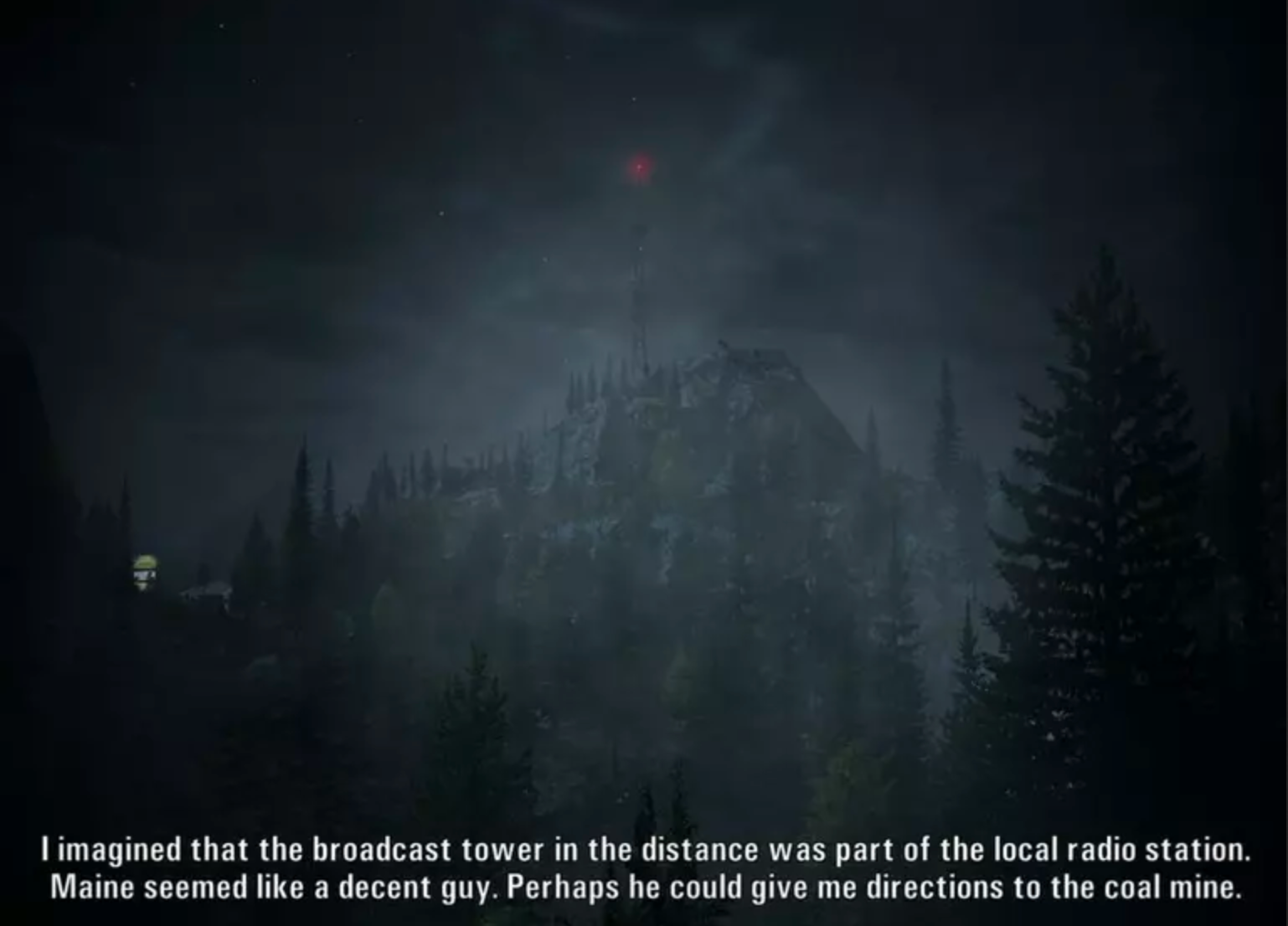
As soon as I started the game proper, I was reminded how much I love the level design in this. I love that you can see atmospheric pools of light, landmarks, and radio towers in the distance, across the forested foothills at night. And then you trek to them! It made me immediately curious about the technical details here, since it had a bit of an open world feel without being written in an open-world engine, if I was parsing what I was seeing correctly.
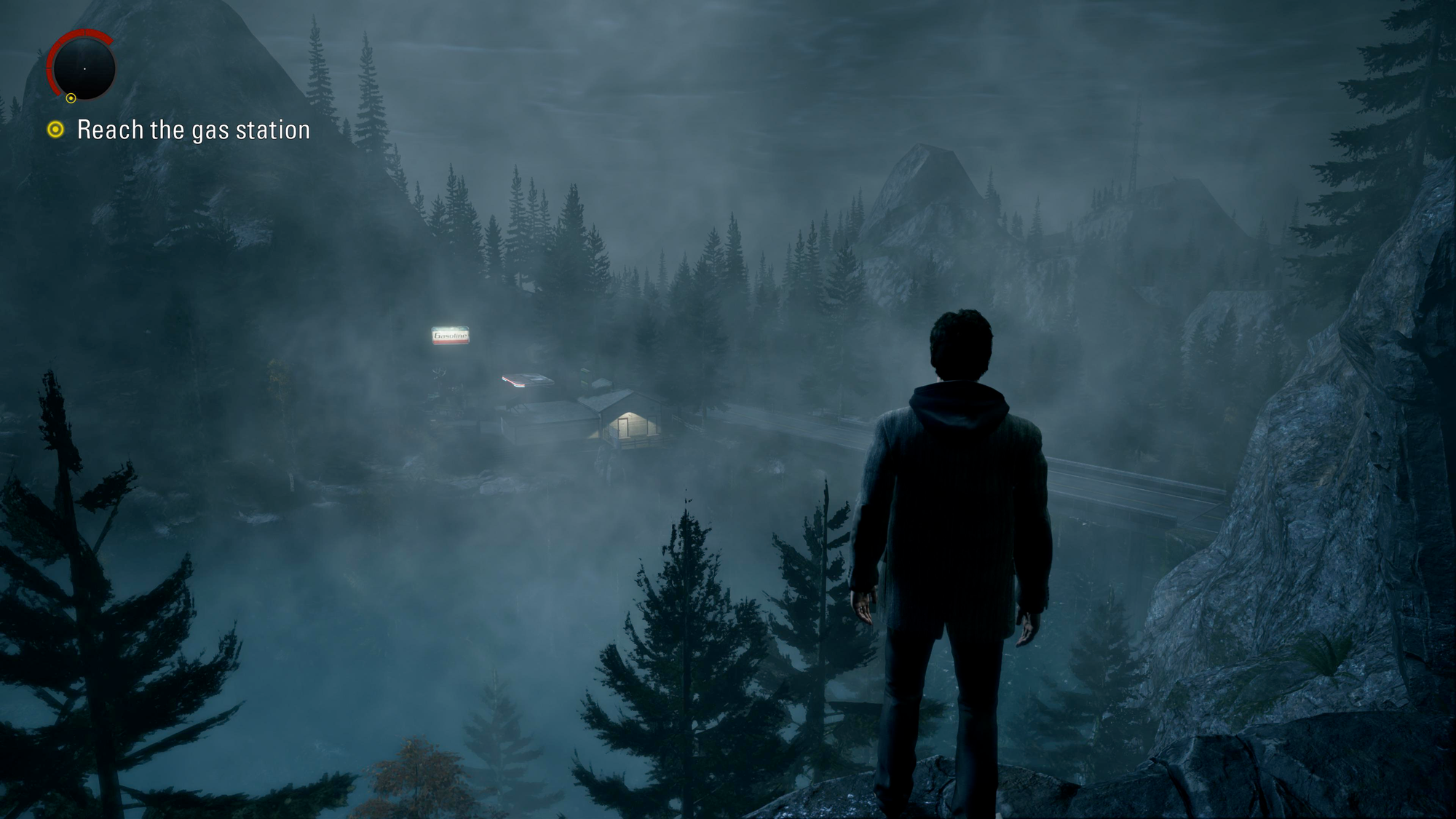
Nowadays, engines can just sort of do this stuff, but there is something very particular about the way Alan Wake looks and behaves while doing it that feels distinctive. It reads like a much newer game (Red Dead, GTA, Uncharted 4) in a lot of visual ways (but, it must be said, not in terms of how fluidly it controls, unfortunately). The weather effects, copious atmospheric fog and day/night lighting differences are tremendous.
A repeated throughline of the game's design is showing you a place in the distance—often during a daylight sequence—and then again asking you to trek to it at night. Sometimes, you'll even have explored a place during the day up close, only to have to navigate it under duress later. All of this contributes to the game's linear levels having a sense of "connectedness" and shared place and therefore more verisimilitude than a game might otherwise have.
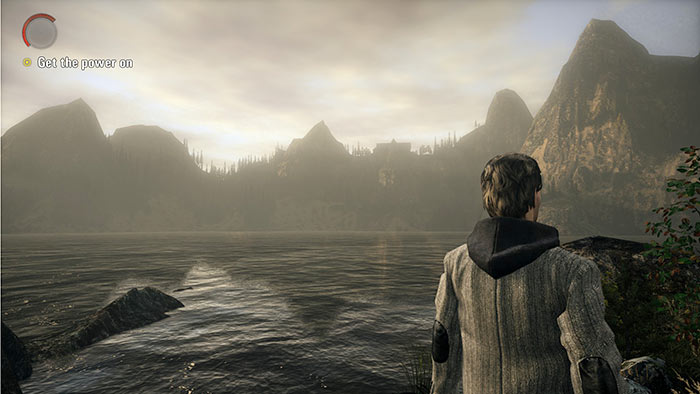
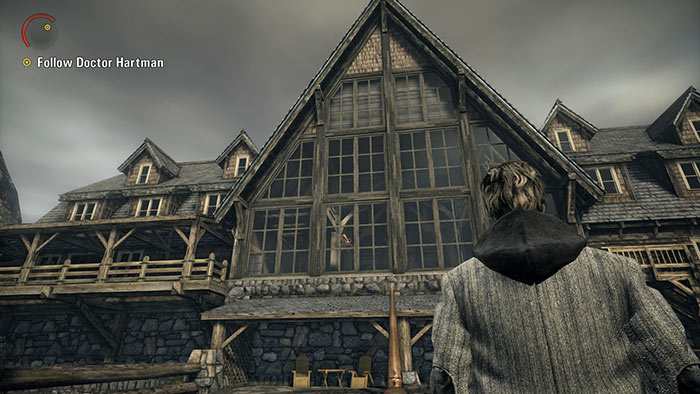
Hey, what's that in the distance? A lodge overlooking the lake! Later, you'll visit the lodge up close and be able to look back down at where you were standing earlier in the game.
After finishing (the main story of) Alan Wake again over the weekend I did a little digging into its development history to see if that revealed anything about its special sauce. And lo, it did!
But first, let's tackle a quick review: how does Alan Wake hold up in 2026? Well, it is still quite good! The game controls like you're an out of shape middle-aged writer—which, OK, fair, Alan is—so older me chose a lower difficulty setting and enjoyed the game more this time than I did fifteen years ago[[2]]. It has a lot of that jumpscare/thriller-horror that is not so much my jam (sorry, Resident Evil), but it is wrapped around a Chambers-ian core that is very much my jam. Playing it on a lower difficulty allowed me to not be bothered as much by the former so I could take in the Twin Peaks™ atmosphere and the parts I do like better. Remedy's thing of putting (short) TV shows you can watch and little radio programs you can listen to in their game remains one of my favorite running gags. The in-game TV show "Night Springs" has some truly good 5-minute Twilight Zone episodes that are worth a look!
"The Dream of Dreams", an episode of TV Alan Wake can watch in the game
The game is 6 chapters long, each generally following the pacing logic of a TV show, which I love. Some "safe" exploration of the story and theme, the inevitable onset of darkness, rising action, a set-piece climax, then a little denouement in a cutscene and <smash, bang> a cliffhanger: episode over. It is built well, though not perfectly–the final chapter lacks a little "extra gear" that would have put it over the top, in my humble. It's not bad, it's just not as well connected in as it could've been. I also found I wanted a little "more" with the lamp lady and the various folks in town. Everything else is pretty great, given the constraints. And let's talk about those, since those turn out to be what provided the "special sauce" here.
It turns out that Alan Wake was supposed to be an open-world game with a base-building "Dead by Daylight" style gameplay loop, with dynamic weather and PacNorwest biome generation... all well ahead of its time. Remedy apparently struggled for years to get the open world to run with all the effects, terrain, and draw distance they wanted, but couldn't do it. On top of that, they loved how strong the narrative they were developing was, but struggled to figure out how to fuse it together with open-world gameplay they envisioned.
So: they tossed the open-world stuff and kept the linear story. They took the map they'd built for the open world game and chopped it up into levels—which goes a long ways to explain why the world feels so "real" and connected. It was planned as a cohesive, lived-in whole and only separated into discrete linear levels later. Ah-HA! This sounds like one of those winding roads that probably felt like a huge stressor and "waste of time" but, I think, the game ended up measurably better for having such a strong sense of space and place. Perhaps this is another example of constraints (engine, gameplay loop, time) coming together to elevate the final design?
It really did end up being something of a masterclass in level design as well as how to deploy atmospheric effects. I remain a big fan of Remedy's storytelling chops, and I'm quite looking forward to giving Control and Alan Wake 2 a shot. Perhaps "later this year"[[3]]
In conclusion: Alan Wake (2010) gets an A- from me. A great game with some truly wonderful environmental design.
[[1]]: OK, OK: it was four years ago. Time is an illusion.
[[2]]: Yes, I used to be the sort of person that played every game on it's hardest difficulty setting. "For fun."
[[3]]: Which could mean anytime through 2030, at this rate!


Comments ()