Nona the Ninth
What an astonishing series this is. Filled with wickedly new and fresh writing, it goes beyond simply eschewing conventional form—it renders conventional form down into constituent parts and rebuilds it into a shambling, undead construct.
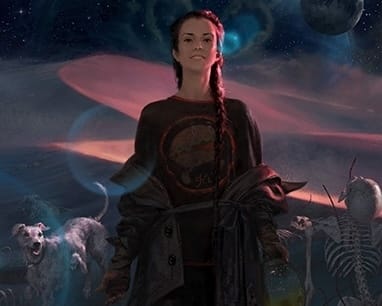
I (finally!) finished Nona the Ninth last night and have now joined the rest of the series' fans in the Alectopause, hoping that Muir is physically able to finish the next book soon. I had to re-read the series entirely before being able to crack on with Nona, since it there is – at the very least – a "lot going on here."
What an astonishing series this is, though. Filled with wickedly new and fresh writing, it goes beyond simply eschewing conventional form—it renders conventional form down into constituent parts and rebuilds it into a shambling, undead construct. You can't even cleanly answer questions like "who survives the events of X the Ninth" because the series' premise defies that: there are more ways to live and die in the world of the Nine Houses than there are in most imagination.
So far, all of these books have come to a definitive and satisfying end, yet Muir has masterfully stage-managed those endings to ask more questions than they answer. And not merely that: to blow open the entire space and trajectory of the series. I aspire to that level of alchemy. The books have never been about what you think they'll be about. Nona is no different. The previous book ended during something of a crisis, so it is jarring to be placed inside this completely new perspective, months later, with only a tenuous understanding of what's been going on. But Nona's charm easily carries you.
She's a sweet, innocent amnesiac child-soul living in a horrific, war-torn city as the Empire collapses into factional and civil (and perhaps lovecraftian-existential) war around her. Her friend group of children struggle to do normal kid stuff like school amongst the rebel factions and the snipers. The pathos is unbelievable – but since it's told from her perspective, and she has no real context: this is just what life is. And she loves freely and easily.
Alix E. Harrow's[[1]] cover blurb cuts to the chase: "You will love Nona, and Nona loves you."
This is a challenging way to tell a story—we, the reader, know many of the people around Nona but have to recontextualize them from her perspective. But since Nona doesn't know anything, "just what is going on around here" must be inferred more often than "seen clearly." As with all of these books, you're going to have to do work to actually understand what's happening in Nona. Very little is handed to you.
The payoff is sublime—another perspective shift; another unexpected widening of the scope; another mystery, and all heralded by a shift in language. I am excited to read whatever comes next, and am thrilled by this journey into the Alectopause.
If I have one criticism it is this: I felt like some of the interstitial material, which delves into the origin story for this freaky little failing space empire, was a little – just a little – too much. Maybe it could have been tightened up a little there.
A+.
[[1]]: Another of my favorite authors. Go read The Ten Thousand Doors of January if you haven't already!



Comments ()